
Imagine your favorite loaf of bread—fresh out of the oven, soft and fragrant. But as days pass, it gradually gets bad—drying out, growing moldy, and finally becoming inedible. This transition from delicious to deteriorated is what we call the product's shelf life.
Much like this loaf of bread, all food products experience a journey from being freshly made to either enjoyed or discarded. The key to ensuring that this journey ends on a high note is understanding how long the product remains fresh and safe to consume. That’s why, after all the innovation and manufacturing, rigorous shelf life testing is crucial in food production.
To truly understand shelf life testing, it is essential to explore the factors that affect food quality externally and internally, as well as its various procedures and the step-by-step process.
Ready to perfect the process of launching well-tested, shelf-stable products? This guide explains everything you need to know to confidently bring your products to market with quality and safety assurance.
What is Shelf Life?
As the name suggests, shelf life determines how long an item can stay on the shelf before it needs to be disposed of.
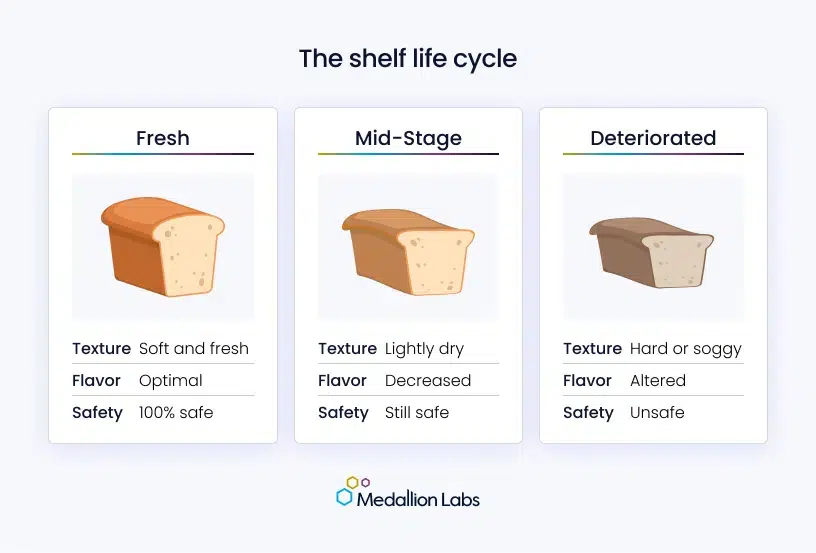
More specifically, shelf life is the duration during which a food product remains safe to store and consume without deterioration in quality, taste, texture, or nutritional value. Let’s break down two key terms here that deserve closer attention: duration and deterioration.
Several factors impact the duration of a product’s shelf life, including its ingredients, packaging, storage environment, and the use of preservatives. Together, these factors influence how long the product stays fresh, flavorful, and nutritious.
As for deterioration, this occurs when a product’s quality begins to decline as it nears the end of its shelf life. Signs of deterioration include staleness, loss of flavor, or texture changes. In some cases, food may even develop harmful bacteria or molds, rendering it unsafe.
But how is this shelf life determined? We are all familiar with “best before” or “expiration” dates printed on the packaging. Behind every date label, there’s a rigorous process known as shelf life testing. This testing assesses the product’s durability and quality under different conditions, determining the exact period in which it can be stored for a given environment.

Did You Know?
Expiration date and best by date are often thought to be the same thing, but they are not. The expiration date is mainly used for products that can become unsafe to consume over time such as raw meat.
Best-by dates apply more to stable, durable products and mark when a product loses its desirable physical traits or develops noticeable off flavors, appearances or textures.
The smell, color, taste, or texture will continue to degrade following the best-by date; however, an individual could still safely consume the item without a risk to food safety, but the experience would just be less satisfying for the consumer.
Shelf life testing is a scientific approach to determining the healthy life of a food product. It involves a range of testing techniques and detailed evaluations to answer crucial questions like:
- What packaging will best preserve your product?
- What storage conditions are optimal for freshness?
- How long will the product maintain its intended quality?
Through these insights, shelf life testing helps food producers understand the ideal ways to store, package, and label their products, ensuring consumers have a satisfactory experience throughout their labeled shelf life.
Shelf life testing is essential for every food product heading to market. Here’s why it’s so important:
- Ensure Consumer Safety: Knowing the right storage and shelf life helps keep consumers safe by making sure they don’t eat products that could be harmful after a certain time.
- Maintains Quality and Upholds Brand Reputation: By determining the optimal shelf life, manufacturers can ensure that food products retain their intended taste, texture, and nutritional value. This not only ensures high-quality products but also strengthens a brand's reputation for delivering great products.
- Supports Compliance and Regulations: Shelf life testing helps businesses comply with food safety rules, preventing potential fines and legal troubles.
- Boosts Consumer Trust: When products consistently meet quality and safety standards, customers gain confidence in the brand and become loyal consumers.
- Enhances Product Longevity and Reduces Wastage: Understanding how different factors affect shelf life helps improve packaging and storage conditions, extending the product's marketable life. Providing the best before and use-by dates also minimizes premature and unnecessary food wastage.
Designing a Shelf Life Study
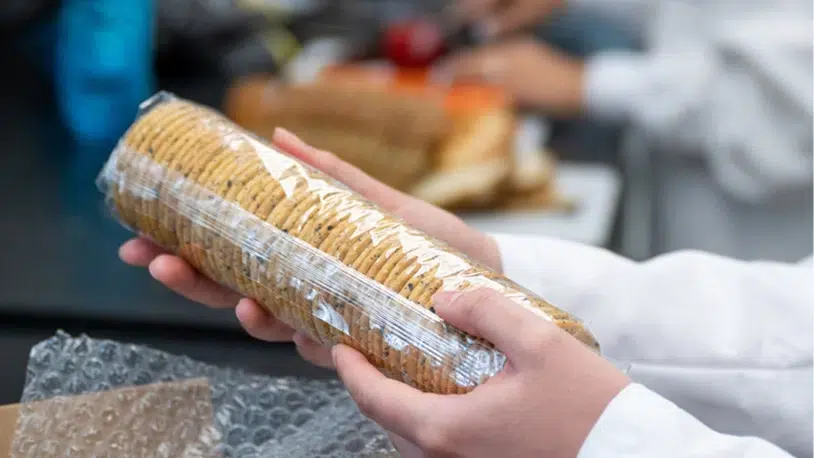
Ambient and accelerated shelf life testing techniques both aim to determine a food product's stability, but they differ significantly in their approach and the accuracy of information they provide. An ambient shelf life study simulates real-world storage conditions. Products are stored at a constant temperature (typically room temperature, though this can vary depending on the product and its intended storage), and their quality attributes are monitored over time at regular intervals. This approach provides the most realistic estimate of shelf life but can be time-consuming, sometimes taking months or even years to complete, depending on the product's inherent stability.
In contrast, accelerated shelf life testing uses higher temperatures or other stressing conditions (e.g., high humidity, light exposure) to speed up the mechanisms of degradation. This allows for a quicker assessment of shelf life, often within weeks or months, compared to the years required for an ambient study, but with a higher potential for artifacts or inaccuracy. It's crucial to understand that the results from accelerated conditions are extrapolations and might not perfectly reflect real-world shelf life. The design involves storing samples at multiple elevated temperatures, allowing for the application of Arrhenius kinetics or other models to predict shelf life at ambient temperature. This extrapolation requires careful consideration of the product's degradation mechanisms and the validity of the chosen model.
While faster, accelerated studies require rigorous validation and careful interpretation to ensure the predictions are reliable. It is often recommended to have components of both ambient testing and accelerated testing methods layered together for optimal accuracy of results while still getting early estimates for timely business decisions.
Difference Between Traditional Shelf Life Testing and Accelerated Shelf Life Testing
The main differentiator between the two processes is the time taken to conduct the test. Here’s a more detailed look at how they differ:
| Feature | Traditional Shelf Life Testing | Accelerated Shelf Life Testing |
| Time Required | Long (actual product shelf life duration, which can be years) | Short (weeks or months) |
| Storage Conditions | Normal storage conditions | Harsher storage conditions (higher temperature, higher humidity, etc.) |
| Cost | High costs due to long testing and storage periods | Lower due to shorter duration |
| Accuracy | Highly accurate because of real conditions | Estimated based on accelerated conditions |
| Data Collection | Periodic testing over the entire testing period | Frequent testing during the accelerated testing period |
Advantages and Disadvantages of ASLT
Accelerated Shelf life testing speeds up the evaluation process, offering several advantages but also some limitations. To help you make an informed decision, let’s explore both the pros and cons of this process, giving you a well-rounded understanding.
Advantages

Early Problem Identification: ASLT speeds up the detection of potential issues, allowing for quick fixes. This proactive approach lets you adjust formulations, packaging, and storage conditions before bigger problems arise.
Enhanced Product and Packaging Insights: ASLT gives brands valuable insights by simulating different storage conditions. It tests both the product and its packaging, ensuring they’re durable and maintain quality in real-world scenarios.
Accelerated Time to Market: ASLT mimics long-term storage in a fraction of the time, leading to quicker testing cycles. This not only speeds up regulatory approvals but also gets your products to market faster.
Lower Development Costs: Shorter testing cycles mean less need for extensive storage, personnel, and lab resources. This efficiency cuts down development costs and boosts revenue potential through faster product launches.
Disadvantages

Potential for Overestimating Deterioration: ASLT can sometimes exaggerate the effects of harsh conditions. This may lead to a shorter estimated shelf life than the product would actually have.
Limited Real-World Accuracy: ASLT speeds up environmental conditions. Because of this, the predicted shelf life might not always match how the product performs in regular storage.
Every Product and Chemical Reaction Within a Product Accelerate Differently: There is no one “rule of acceleration” for all products. Every reaction within a product reacts differently to temperature so samples from accelerated shelf life testing can show roughly what a product would look like at a given time point, but not exactly. Also, without well established historical shelf life data, accelerate rate estimates for products can be inaccurate resulting in over or under prediction of shelf life.
Not Suitable for All Products: ASLT isn't ideal for every product. Some are too sensitive to specific conditions, while others degrade in ways that ASLT can't easily replicate.
Due to these limitations, accelerated shelf-life testing is best executed with traditional, non-accelerated testing in parallel. This combination allows you to quickly adjust the product and packaging while using traditional testing to confirm that the results hold up under normal storage conditions.
Key Metrics to Monitor Ingredient Impact
Moisture Level
We’ve all experienced food that’s fresh and crisp one day, only to become soggy or inedible by the next. What changed overnight? The food product absorbed moisture (or in some products lost moisture) and lost its perfect state of consumption. There are two main considerations for moisture levels in food shelf life—the product’s starting moisture and critical limits and the packaging moisture barrier properties.

For your consideration
To understand moisture’s impact on a product, we need to understand the moisture level of the product at the moment of packaging, and the corresponding moisture level the product is no longer acceptable for consumers. These are typically referred to as the "production moisture range" and the "critical moisture," respectively.
Let's use a breakfast cereal with raisins as an example. The production moisture range for the blended moisture of the flakes and cereal is likely between 8-9%. This is the moisture level of the product when it leaves the manufacturing plant. The flakes may become very tough at around 10.5% blended moisture, and the raisins may become tough at around 6.5-7% moisture. Thus, we must select a packaging film that provides adequate protection to ensure that all of the components of the food stay within the storage moisture range over the shelf life of our product.
You can test moisture levels in food two main ways. The standard moisture test determines moisture content by assessing weight loss after heating a sample in an oven under controlled conditions. The weight loss percentage indicates moisture content, while the remaining percentage represents solids. This method is suitable for nearly all food and food-related products, except for samples containing significant amounts of substances (other than water) that may evaporate when heated or exposed to a vacuum.
The other option is the Karl Fischer Titration Test, which tests pure shortenings, oils, or high-fat samples. Under this method, moisture determination involves automated potentiometric titration using a reagent mixture of iodine and sulfur dioxide. Moisture is extracted from the sample into a suitable solvent and then measured through volumetric titration rather than colorimetric titration.
It is crucial to understand how standard moisture and the Karl Fischer Titration Test work and how they vary to use the ideal test and assess the food product quality and preservation.
| Aspect | Moisture Test | Karl Fischer Titration Test |
| Method | Measures weight loss by heating samples in forced air or vacuum ovens. | Uses chemical titration to quantify water molecules directly. |
| Suitability | Best for general food products and ingredients. | Suitable for high-fat, oily samples or those containing volatile compounds. |
| Application | Broadly applicable to most food matrices. | Ideal for products where heating may cause degradation or volatilization of non-water substances. |
| Advantage | Simple and cost-effective for most samples | High accuracy for challenging matrices like oils or glycerol-based products. |
| Limitation | Not suitable for volatile or high-fat samples. | More complex and requires chemical reagents. |
Oxidation Rates
Monitoring oxidation in fat-containing foods is crucial for determining shelf life and maintaining product quality. The process of oxidation, where fats and oils react with oxygen, leads to rancidity, characterized by off-flavors, unpleasant odors, and in very high concentrations, potential health risks. By carefully measuring the rate of oxidation, manufacturers gain valuable insights into the product's susceptibility to spoilage. This is typically done through various analytical techniques, such as measuring peroxide value (PV), hexanal, or analyzing volatile compounds responsible for rancidity.
The data obtained from oxidation rate monitoring directly informs strategies to extend shelf life. For instance, if a high oxidation rate is observed, several interventions can be implemented. Storage conditions can be adjusted to minimize oxygen exposure. This might involve using modified atmosphere packaging (MAP), which replaces air with a mixture of gases like nitrogen and carbon dioxide to reduce oxygen levels. Alternatively, storage temperature can be lowered, as oxidation reactions generally proceed faster at higher temperatures.
Beyond storage changes and antioxidants, the data on oxidation rates can also inform packaging design. This could involve using packaging materials with improved oxygen barrier properties, such as metallized films or specialized polymers. Ultimately, by understanding the oxidation kinetics of a fat-containing food, manufacturers can develop comprehensive strategies to control rancidity, extend shelf life, and ensure the product remains safe and palatable for consumers. This involves a combination of careful ingredient selection, optimized processing techniques, appropriate storage conditions, and effective packaging design.
Water Activity
Monitoring water activity (aw) is critical for predicting and controlling microbial growth in food products, a major factor influencing shelf life. Water activity, representing the availability of water for microbial use, is a more accurate predictor of microbial growth than moisture content alone. Microorganisms require a certain level of aw to grow and reproduce; reducing aw below this threshold inhibits microbial activity, extending shelf life. This is typically measured using instruments like water activity meters.
The data obtained from aw measurements directly informs strategies to control microbial growth and extend shelf life. If a high aw is measured, indicating a risk of microbial spoilage, several interventions can be implemented. Formulation adjustments can reduce aw. This might involve adding humectants, which bind water and reduce its availability, or using ingredients with lower inherent moisture content. Processing techniques like drying, dehydration, or concentration can also effectively lower aw. Furthermore, the data can guide the selection of preservation methods. These could include adding preservatives that inhibit microbial growth, such as organic acids or salts. Controlling the storage environment is also crucial; maintaining low temperatures slows microbial growth, even at higher aw levels.
Sensory Attributes
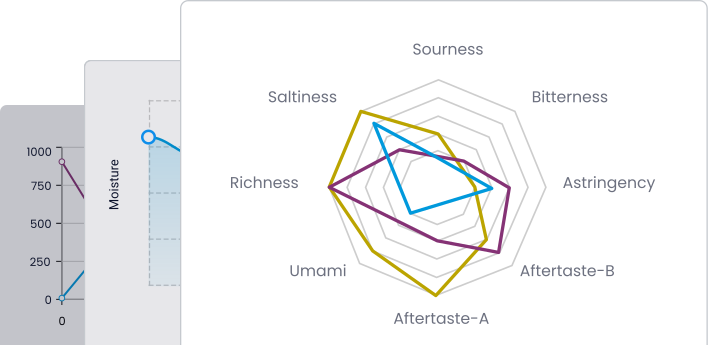
Understanding the organoleptic changes that occur in a product helps determine what a consumer will experience as their product ages on the shelf. Sensory attributes encompass all aspects perceived by the senses and their changes over time indicate deterioration. These changes can be subtle initially, but they progressively impact consumer acceptability and ultimately determine the product's shelf life.
Sensory evaluation at Medallion uses a difference-from-target approach. Trained panelists compare test products to a reference sample (product at time zero, stored at low temperatures to minimize changes). A 5-point scale measures the difference as products are evaluated for changes in texture, aroma, appearance, and flavor. This allows comparison of how different products change over time. Panels typically consist of 4-5 panelists, following industry best practices for training and methodology.
Label Claims
Shelf life testing can also verify any label claims made by the manufacturer. For example, many products make claims about vitamin and mineral content. Many food products are fortified with vitamins, or naturally contain vitamins that are susceptible to degradation during storage. Label claims often state the vitamin content at the time of manufacture, sometimes including statements about retention percentages after a certain period.
Shelf life testing specifically addresses the accuracy of these claims by monitoring vitamin levels over time under various storage conditions. This involves using analytical techniques like HPLC (High-Performance Liquid Chromatography) or other suitable methods to quantify the amount of specific vitamins present in samples taken at regular intervals.
The data obtained allows manufacturers to determine the actual rate of vitamin degradation and to verify whether the labeled vitamin content is accurately reflected throughout the product's shelf life. If the testing reveals significant vitamin loss exceeding the claimed retention, it necessitates adjustments to the product formulation, packaging, or storage recommendations to better preserve vitamin content and ensure the accuracy of future label claims. This rigorous testing process is essential for maintaining consumer trust and complying with regulations regarding nutritional labeling.
Product Packaging
The type of product packaging directly impacts how long a product remains safe for consumption and how well it holds up during transportation. Proper packaging is crucial for maintaining product integrity from production to the consumer's hands.
Here is what different types of packaging offer:

Glass: Glass is an excellent barrier against oxygen and moisture, making it ideal for preserving the freshness and flavor of food products. However, it's fragile and heavier than other materials, which can increase transportation costs and risk of breakage.

Plastic: Plastic packaging is versatile and lightweight and can be used in its ability to be molded into different shapes and sizes. However, not all plastics offer substantial barriers against oxygen and moisture, so selecting the right type of plastic is crucial

Paper and Cardboard: These materials are commonly used for dry foods and secondary packaging. While eco-friendly and lightweight, they typically require an additional barrier layer, such as plastic or wax, to protect against moisture and contamination.
Choosing packaging that matches your product’s unique environmental needs is crucial. It’s also vital to ensure the packaging is sealed tightly to avoid leaks and contamination. Implementing these practices can greatly extend your product’s shelf life and preserve its quality.
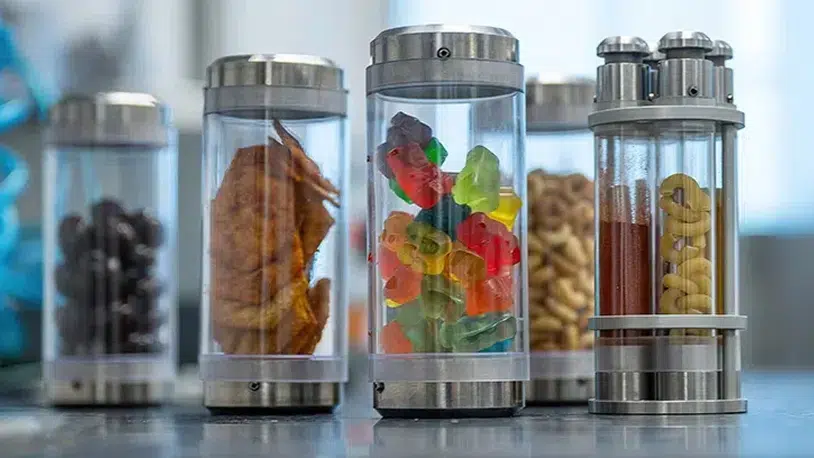
Traditionally, shelf life studies involved lengthy observation of products in various conditions. Medallion has a number of other options that can determine how packaging will hold up in different scenarios and how that affects the product. Some of the options include:
- Moisture Isotherm: Creating a linear model (water activity vs. moisture) for the product.
- WVTR (Water Vapor Transmission Rate): Obtaining WVTR data from packaging suppliers (for the film) and/or running gravimetric package WVTR tests (to account for seal leakage in the formed package).
- Package Modeling: Using the isotherm, WVTR, fill weight, and package surface area in a modeling system to predict shelf life in any global destination. This allows for quick assessment of shelf life changes due to altered package sizes or new materials without lengthy testing. It also helps determine the impact of changes in product moisture content (e.g., due to faster factory lines). The model incorporates temperature and humidity data from around the world to predict shelf life variations in different regions. It focuses on moisture migration and provides insights into moisture limited shelf life changes due to climate. It can also be used to predict when moisture loss becomes problematic or when mold risk increases.
- Light Studies: Light studies are crucial for photosensitive products (e.g., dairy). The focus is on the intensity and type of light exposure during the limited time products spend in display cases, not the total shelf life. We have several conditions based on light intensity measurements in various store display cases. Monitoring products during and after exposure to these light conditions determines how much light exposure a product can tolerate before noticeable sensory changes occur.
Supply Chain Impact
A product's shelf life is significantly impacted by the efficiency and conditions of its supply chain. Fluctuations in temperature during transportation and storage, exposure to light or humidity, and the length of time spent in transit all contribute to degradation. Medallion has options to track the effects of supply chain abuse.
Cycling Weather Room: A condition that is often built into our layered shelf life protocols is the weather room which tracks the effects of temperature and humidity abuse that may occur as a product sits in a truck or warehouse over the typical summer season in North America. The temperature of the chamber fluctuates every 12 hours to simulate uncontrolled storage conditions.
Shaker Table Analysis: The shaker table test replicates the vibrations a product endures during distribution (e.g., in a truck). It compresses weeks of gradual vibration into a few hours of higher-frequency shaking. This test, combined with varying temperatures, reveals how temperature abuse and vibration affect product appearance and potential consumer issues. For example, it can show if chocolate smears in its packaging after temperature abuse and vibration. This helps determine the need for temperature-controlled shipping or temperature limits.
6 Factors Food Testers Need To Achieve Accurate Results
Here are some quick tips to keep in mind while engaging in the shelf-life testing procedure:

Testing Factors
Some companies use a "test and estimate" strategy to gauge shelf life. They replicate conditions in environments like a boxcar or a Florida warehouse during the summer and then infer how these outcomes might apply under milder conditions. The assumption is that one week of exposure to such harsh conditions could equate to a month of regular storage.
However, such assumptions can often be misleading. Elevated temperature and humidity are typically employed to speed up shelf life assessments. Yet, the relationship between extreme and normal storage conditions varies significantly across different food categories. To validate these assumptions, either multi-condition testing or extensive prior experience with similar foods is essential.

Establishing Limits
Producers must identify whether the product's storage quality undergoes noticeable changes over days, weeks, or months. Reliable shelf limits depend on understanding four critical elements:
- The product's inherent stability.
- The influence of distribution on storage quality.
- The role of ingredient quality, processing methods, and packaging in storage durability.
- The threshold at which quality diminishes, rendering the product unfit for consumption.
Despite thorough shelf life studies, tests often rely on a single product lot, limiting the findings. It's hard to determine if that lot represents average, optimal, or subpar quality in terms of ingredient sourcing, supply chain management, or production conditions. Combining well designed shelf life studies along with thorough understanding of your process variability allows for the proper establishing of well reasoned product code dates.

Testing Requirements
Gathering specific product details is essential before launching shelf-life tests. Key attributes like moisture content and water activity (aw) must be understood. Other important characteristics might include fat type and content, protein levels, starch and sugar composition, ash content, and pH levels. Microbiological testing may also be necessary for high-moisture items.
The main goal of shelf life testing is to monitor how fast chemical, physical, or microbiological changes occur during storage and distribution. Since some changes are more likely under specific conditions, prior knowledge about potential degradation processes is highly beneficial in designing a shelf life specifically targeted to the failure mechanism of a product.
It’s worth noting that water activity is only an indicator. Some microorganisms can thrive at lower aw levels, and lipid oxidation can occur even in high-moisture environments.
Food products tend to gain or lose moisture over time unless packed in the highest barrier materials (such as glass jars and metal cans). These changes can directly alter texture or indirectly accelerate deterioration. To predict these effects, foods can be placed in controlled environments, like saturated salt solutions, to assess equilibrium moisture levels. By plotting these results, a moisture sorption isotherm—a graph representing equilibrium moisture content at various relative humidities—can be created..

Test Package Concerns
To properly understand how a packaging material impacts product stability, it is vital that products be tested in the packaging material or material options that are to be used in normal manufacturing and with the desired fill weights and package dimensions. If this is not done, the study results may not accurately represent the shelf life of the actual production product. It is preferred to have the packages run at normal speeds on actual production lines when possible as this will be most representative of the actual products consumers will see..

Rate of Deterioration
Determining how quickly a product's quality declines is not always straightforward. If a food product undergoes significant quality shifts in a short time, measuring the deterioration rate is relatively easy. However, when changes are slow and subtle, it becomes difficult to distinguish between natural quality fluctuations and actual deterioration, even when using control samples stored at extremely low temperatures like 0°F or -40°F.

Organoleptic Changes
Evaluating samples by smelling and tasting them is a key part of shelf life assessments. This sensory approach helps testers identify the different phases of degradation. However, sensory evaluations can be subjective and unreliable if conducted by only a few individuals, as taste sensitivity varies between people. Our sensory panelists are trained and calibrated on a regular basis to eliminate subjectivity to produce repeatable and reliable quantitative data.
Step-by-Step Shelf Life Testing Process
Here is a step-by-step guide to take you through the process of shelf-life testing:
Initial Consultation
Our testing team will engage with you to understand the specific goals and objectives for your shelf life study.
Tailored Protocol Creation
The stability team will design a custom protocol that ensures all the essential data you need is gathered.
Protocol and Quote Review
You will receive the proposed protocol and a detailed quote for your review. Once you give the green light, we’ll move forward with the study.
Study Launch
Samples will be placed in the predetermined conditions, and we'll assess your product at the scheduled time points.
Mid-Study Update
After completing the accelerated phase of the study, you'll receive a report with a preliminary shelf life estimate. This allows you to make informed decisions about your product’s expiration date.
Final Study Report
Upon concluding all testing, we will provide a comprehensive final report. This report will confirm the initial estimates from the accelerated phase and offer a full overview of the product’s stability.
Shelf Life Pricing
Pricing for shelf life studies can vary widely depending on needs. Each of our protocols and quotes is custom designed so there is no one-size-fits-all price for a study.
Factors Influencing Shelf Life Testing Costs:
- Number of Products: Testing multiple products simultaneously increases the workload, requiring more resources and thus impacting the overall cost.
- Study Duration: Longer studies naturally require more frequent testing intervals and analysis, leading to higher expenses. A one-year study will inherently cost more than a six-month study.
- Number of Storage Conditions: The number of different storage conditions (e.g., temperature, humidity, light exposure) under which your product is evaluated significantly impacts the cost. Testing across multiple conditions requires more samples, more testing time, and more extensive analysis, leading to a higher overall price.
- Analytical Testing Requirements: The complexity of the analytical testing needed significantly influences the price. Some products may only require basic assessments, while others might necessitate sophisticated chemical, microbiological, or sensory analyses. The more extensive the testing, the higher the cost.
Typical Cost Range & Payment Structure:
While pricing is highly variable, a one-year shelf life study for a single product typically falls within the $3,000-$7,000 range. However, this is just a general guideline. Factors mentioned above can easily push the cost above or below this range.
To ensure transparency and mitigate financial risk, we utilize a phased invoicing system. You are billed at each testing interval (or "pull"). This means that if your product fails to meet stability criteria, or if the study needs to be terminated prematurely for any reason, you only pay for the completed testing phases. This flexible payment structure protects you from unnecessary expenses.
What Certifications Matter for Shelf Life Studies?
When selecting a lab for shelf life testing, certifications are one of the most important indicators of quality, reliability, and regulatory compliance. The right certifications ensure that the lab follows validated methods, operates under a robust quality system, and delivers data you can trust for both product development and regulatory submissions.
One of the most important credentials to look for is ISO/IEC 17025 accreditation. This international standard confirms that a lab's analytical methods and quality management system meet rigorous, internationally recognized requirements for the competence of testing laboratories. It ensures testing is accurate, consistent, and traceable.
In addition to ISO accreditation, participation in proficiency testing programs is a key signal of ongoing performance validation. Leading labs often participate in programs such as:
- AACC – for testing flour quality, dietary fiber, beta-glucan, fat, fatty acids, sugar, vitamins, minerals, and proximates
- API – for microbiological analysis
- AOCS – for fats and oils testing
- FAPAS – for pesticide residue analysis
- LGC – for mineral content testing
Finally, labs recognized under international frameworks like the International Laboratory Accreditation Cooperation (ILAC) benefit from mutual recognition agreements, which help streamline global acceptance of results.
Together, these certifications and programs signal that the lab can deliver reliable data that supports accurate shelf life determinations—whether you’re testing for microbial stability, nutrient degradation, moisture loss, or package integrity over time.
Conclusion
Shelf life testing is vital before introducing any food product to the market. It bridges the gap between consumer safety and product excellence, ensuring that you not only protect the well-being of your customers but also elevate product quality, select the optimal packaging, and strengthen your brand's reputation for delivering premium goods.
Therefore, investing in comprehensive shelf life testing ultimately leads to better products and a stronger, more trusted brand.
At Medallion Labs, we streamline this process by guiding you through a comprehensive, step-by-step journey that thoroughly assesses your needs, making shelf life testing a seamless experience. Our commitment is to provide fast, accurate insights into your product’s shelf life, enabling you to innovate and launch high-quality products swiftly, keeping you ahead of the competition.
Contact us today and experience a hassle-free approach to shelf life testing.
Shelf Life Testing at Medallion Labs
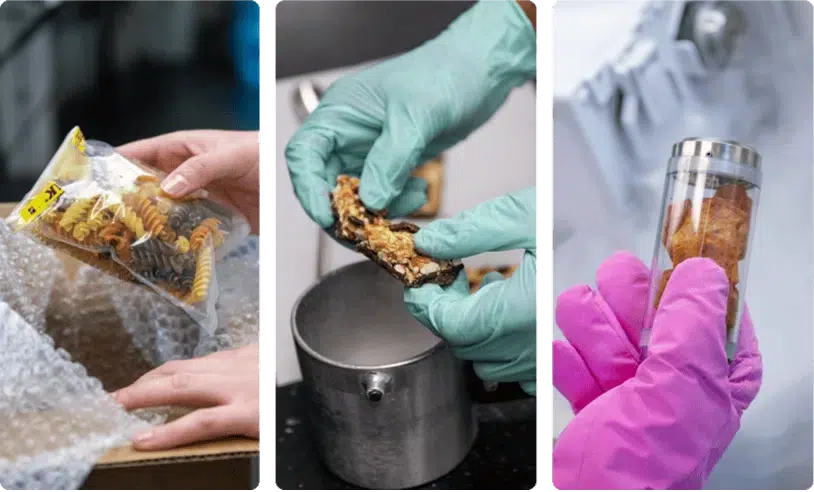
Medallion Labs provides a range of food testing options with mid-market and enterprise food and ingredient manufacturers in mind. Our white-glove customer service and priority processing ensure you can focus on innovation and manufacturing while we handle product testing for you.
With over 150 years of experience, we design a custom approach for each customer to meet individual food testing requirements. Partnering with us means more than just accessing expert food testing; it means having a dedicated partner committed to simplifying your process and ensuring your product launch is successful.
We evaluate food quality throughout its lifecycle and pinpoint key quality challenges. Our comprehensive testing covers four critical stages:
- Product failure modes
- Post manufacturing degradation
- Packaging degradation
- Consumer experience

We are ISO/IEC 17025 accredited and participate in numerous proficiency testing programs, including AACC (flour quality, fiber, beta-glucan, fat, fatty acids, sugar, vitamins, minerals, and proximates); API (microbiology); AOCS (edible fats and oils); FAPAS (pesticides); and LGC (minerals).

We are also internationally recognized through a Mutual Recognition Agreement with the International Laboratory Accreditation Corporation (ILAC).

Getting a Precise Shelf Life Quote From Medallion Labs:
To obtain an accurate quote for your specific shelf life testing needs, please contact us with details about your product(s), desired study length, the number of storage conditions to be tested, what failure modes you would like to track, and the analytical testing requirements. Our team will work with you to develop a customized study plan and provide a detailed cost breakdown.
Our food testing experts are here to help.
"*" indicates required fields
